The Hedge Study Circle 20.06.26 Archipelago, Migrant and Rhythmic Counterpoint
Seeing ‘the entire world as a foreign land’ makes possible originality of vision. Most people are principally aware of one culture, one setting, one home; exiles are aware of at least two, and this plurality of vision gives rise to an awareness of simultaneous dimensions, an awareness that – to borrow a phrase from music – is contrapuntal.
Edward Said, Reflections on Exile (2013)
We arrived at the evening Hedge Study Circle to the sound of the counterpoint, the clapping, a reminder from convenor Dr Ciara Igbo, that working with ideas together can be formed as a rhythm, it doesn’t have to take the linear, verbal interaction of dialogue – the topic of the first presentation below.
What might a classroom be that thinks with different bodily senses, that listens to the sound of minds and bodies working with different speeds, bringing different habits of time? How can new forms of commonality, or perhaps, uncommonality happen?
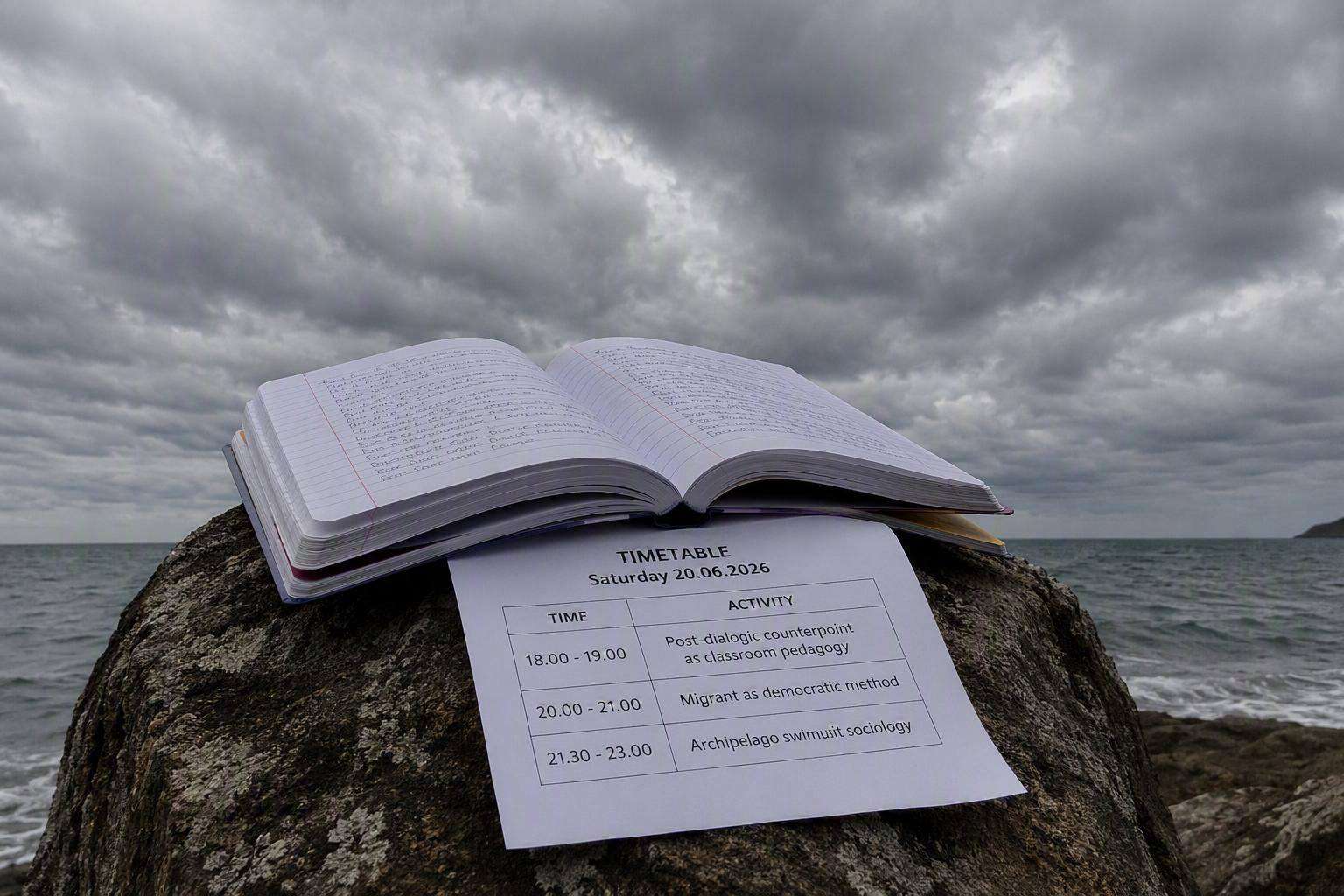
18.00-19.00 Post-dialogic counterpoint as classroom pedagogy
20.00-21.00 Migrant as democratic method
21.30-23.00 Archipelago swimsuit sociology
The next hour we the discussed passages below from Thomas Nail’s The Figure of the Migrant (2015).
The migrant has been predominantly understood from the perspective of stasis and perceived as a secondary or derivative figure with respect to place-bound social membership. Place-bound membership in a society is assumed as primary; secondary is the movement back and forth between social points. The “emigrant” is the name given to the migrant as the former member or citizen, and the “immigrant” as the would-be member or citizen. In both cases, a static place and membership are theorized first, and the migrant is the one who lacks both. Thus, more than any other political figure (citizen, foreigner, sovereign, etc.), the migrant is the one least defined by its being and place and more by its becoming and displacement: by its movement. If we want to develop a political theory of the migrant itself and not the migrant as a failed citizen, we need to reinterpret the migrant first and foremost according to its own defining feature: its movement […] In a political sense, the theory of the migrant, viewed from the primacy of movement, may even present a more inclusive model of international relations than citizenship currently does. The migrant is not only empirical but also prefigures a new model of political membership and subjectivity still in its early stages. Thus, there are empirical migrants, but their meaning and potential extend beyond their empirical features under the current conditions of social expulsion. What would it mean to rethink political theory based on the figure of the migrant rather than on citizenship?
(Nail, 2015, pp. 3/17)
How can movement rather than stasis become a value in itself? How might it be joyful and enable dignity for all? Instead of removing the rights of our migrant doctors, teachers, careworkers, cleaners, business-people, farm-workers, baristas, artists, scientists, we need to spend energy and resource rethinking ideas of state and citizen. What more expansive and creative forms of economy, community and obligation might a Fifth Province enable? What teaching might we need to develop as an alternative to citizenship classes?
Spaced Out with Glissant
As the sun began to set, we swam out to the island to listen to Professor M.A. Ali’s exploration of Fifth Province as archipelago, through the work of Edouard Glissant’s Poetics of Relation. The Fifth Province assumes and implies a relation to the stasis of the Four, a Fifth Province is made up of the already migrant and moving, a poetics of relation and teaching where we figure out on the move, when you make, where you make, which rhythm you make it with, learning about who is making you with a Fifth Province, awkwardly overstepping with joy, learning to dance a Fifth Province with them.
Imaginary
Thinking thought usually amounts to withdrawing into a dimensionless place in which the idea of thought alone persists. But thought in reality spaces itself out into the world. It informs the imaginary of peoples, their varied poetics, which it then transforms, meaning, in them its risk becomes realized. Culture is the precaution of those who claim to think thought but who steer clear of its chaotic journey. Evolving cultures infer Relation, the overstepping that grounds their unity-diversity. Thought draws the imaginary of the past: a knowledge becoming. One cannot stop it to assess it nor isolate it to transmit it. It is sharing one can never not retain, nor ever, in standing still, boast about." Glissant, Édouard (1990/2025) Poetics of Relation, Penguin.
As Glissant's thinking began spacing itself in the gathering, it reminded me of a mixtape my friend Jamie made for me in the early 90s - "Spaced-Out". Like all original thought Glissant spaced us out into that risky relation of thinking, feeling and making without the reference points and norms of a predefined community:"Culture is the precaution of those who claim to think thought but who steer clear of its chaotic journey." Making new stuff together is always excessive, always exceeds for a moment governing standards, of value, of understanding and of feeling. "Evolving cultures infer Relation, the overstepping that grounds their unity-diversity." Education might become less about creating assumed ideas of belonging and more about poetic relations of overstepping and spacing out.
Overstepping. But also Understepping, as SJ reminded us as he danced us off the island on the riverboat, moving to the contrapuntal Drop (1995), The Pharcyde’s secret Physics of the Archepelago.
Because they envy me and the making of my mad currency
Currently I think we're in a state of an emergency (say what?)
References
Glissant, Édouard (1990/2025) Poetics of Relation. Penguin.
Nail, Thomas (2015) The Figure of the Migrant. Stanford University Press
Reich, Steve (1972) Clapping Music
Said, Edward (2013) Reflections on Exile. Granta Books
The Pharcyde (1995) Drop